
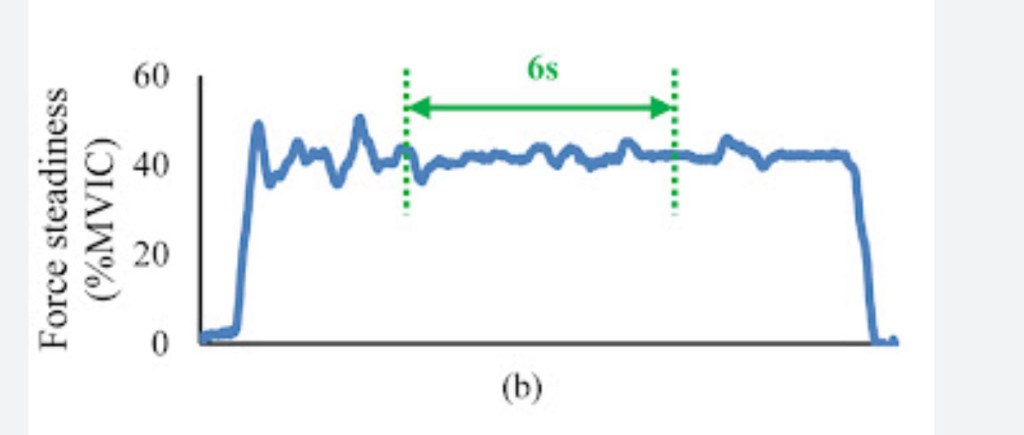
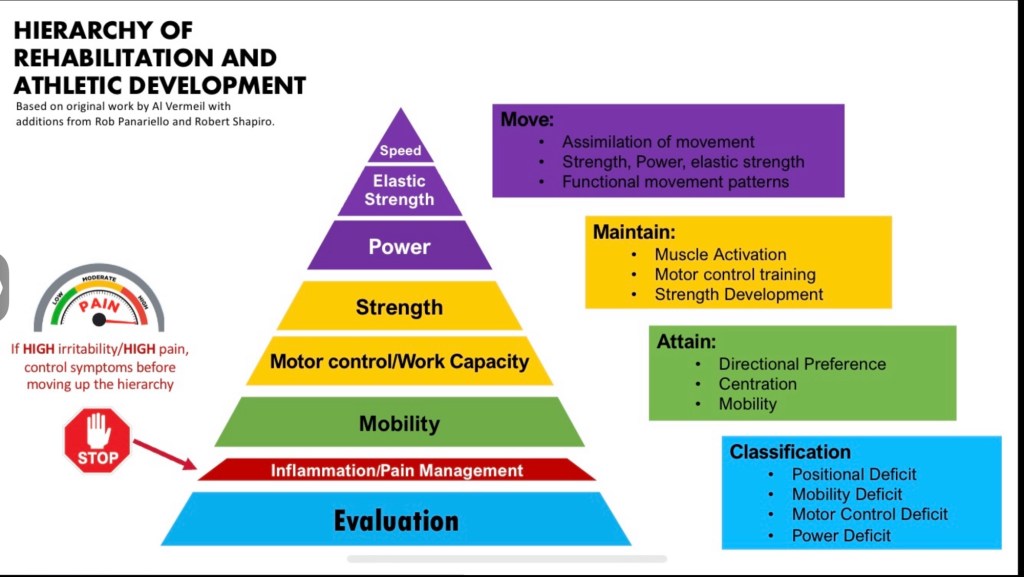
Force steadiness, the ability to maintain consistent muscle force during submaximal contractions, is crucial for effective motor control and plays a significant role in the rehabilitation pyramid. This testing is particularly important during the evaluation and motor control phases, ensuring that patients build a solid foundation before advancing to more intensive strength and power training. Key brain regions involved in force steadiness include the motor cortex, responsible for executing voluntary muscle movements, the premotor cortex, which plans and coordinates complex movements, and the cerebellum, which fine-tunes motor activities to ensure precision and coordination.
Motor Control Activation Testing vs. Strength Testing
Motor Control Activation Testing:
Muscle activation testing, also known as force steadiness testing, focuses on assessing the nervous system’s ability to maintain a steady force during submaximal contractions. This method evaluates motor control and the efficiency of the neuromuscular system in producing a consistent and controlled force. It involves tasks that require maintaining a steady force at a specified percentage of the maximum voluntary contraction (MVC) over a set duration. This type of testing is crucial for understanding the smoothness and coordination of muscle activation, which is essential for performing precise movements in daily activities and sports.
Strength Testing:
In contrast, strength testing measures the maximal force a muscle can produce during a single contraction. It assesses the peak force output of the muscle, which is essential for building overall muscle strength and power. Strength testing involves performing maximum effort tasks, such as lifting the heaviest weight possible, and is a critical component in strength training programs designed to increase muscle mass and force production capabilities.
Implementing Force Steadiness Testing
Implementing force steadiness testing involves a straightforward setup with visual feedback, which helps patients adjust their force output in real-time, enhancing motor control. The training protocol typically includes calculating one maximum voluntary contraction (MVC), performing calculations at 30-50% of MVC, and training at 5% of the calculated value. Research has shown that training at these levels significantly improves motor performance and stability. For example, Hirono et al. (2020) demonstrated that training at 5% MVC significantly improves force steadiness and control. Studies by Enoka et al. (2014) and Justice et al. (2014) have also shown the benefits of visual feedback during training in enhancing motor control and reducing force fluctuations.
In practical applications, a study on patients with chronic ankle instability (CAI) revealed that these patients often exhibit deficits in force steadiness and accuracy in the ankle evertors and invertors, as well as the hip abductors. Rehabilitation programs that focus on restoring proprioceptive functions of the ankle and hip, along with visual training, have been shown to improve force steadiness and motor control in these patients. Additionally, specific protocols such as performing exercises for durations of 10-15 seconds with 5 repetitions, focusing on maintaining a steady force at 10% or 30% of MVC, have been recommended to enhance steadiness and accuracy (Lee et al., 2016; Marmon et al., 2011).
By understanding and utilizing force steadiness testing, therapists can design more effective rehabilitation programs. This approach ensures safe progression through the rehabilitation pyramid, ultimately leading to better patient outcomes and smoother, more controlled movements.
References
- Hirono, T., et al. (2020). “Relationship between postural sway on an unstable platform and ankle plantar flexor force steadiness in community-dwelling older women.” Gait & Posture.
- Enoka, R. M., et al. (2014). “A unique form of light-load training improves steadiness and performance on some functional tasks in older adults.” Scandinavian Journal of Medicine & Science in Sports.
- Justice, J. N., et al. (2014). “Fatigability of the dorsiflexors and associations among multiple domains of motor function in young and old adults.” Experimental Gerontology.
- Lee, H., et al. (2016). “Submaximal Force Steadiness and Accuracy in Patients With Chronic Ankle Instability.” Journal of Athletic Training.
- Marmon, A. R., et al. (2011). “Practicing a functional task improves steadiness with hand muscles in older adults.” Medicine & Science in Sports & Exercise.
 Shapiro's Manual Therapy Corner